ASX 200 Live Today - Wednesday, 2nd September
The ASX 200 is trading sharply lower as miners and tech stocks tumble. Here are today's top stories.

Today’s ASX 200 Updates
Welcome to our live ASX coverage for Wednesday, September 2. Expect a high volume of posts pre-market and more periodic updates throughout the day. We'll be wrapping the blog up around 2:00 pm AEST. Let us know how we can make it even better.
A rough day in the office
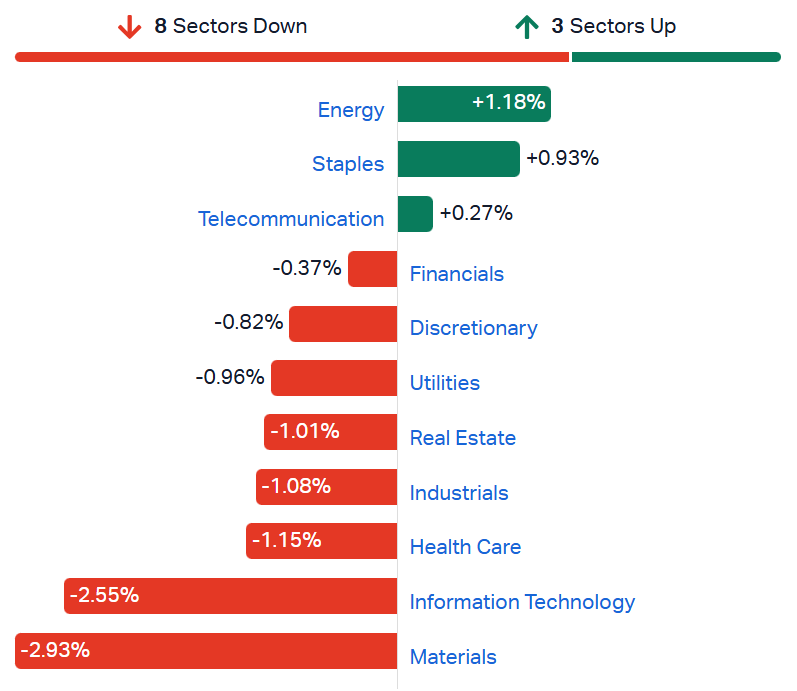
[1:55 pm] The ASX 200 is down 110 pts (-1.21%), trading near intraday lows. Today was a classic flight to safety, with sectors like Telcos (+0.54%), Staples (+0.28%) and Financials (+0.02%) holding up, while anything growth-related or sensitive to yields tumbled. Materials (-3.6%), Tech (-3.1%), Real Estate (-1.3%) and Utilities (-1.2%) all sold off sharply.
Honestly, we could just copy and paste yesterday's closing post:
I'm not gonna lie, you look at some of the data out there and it feels like we're in a rough patch for equities. September is the worst month of the year for most global equity benchmarks. The S&P/ASX 200 Total Returns Index averages a 0.65% decline for the month and finishes higher just 44% of the time, the worst on both measures. Then there are yields. Aussie and US two and three-year yields are breaking out to early 2025 levels, while the long end keeps grinding to multi-year, if not multi-decade, highs. Commodities, meanwhile, refuse to budge. Brent is trading around US$91 a barrel and downstream products like diesel futures are near record highs. Softs have joined in too, with corn and wheat both up 18-19% in the past month. We might be able to print infinite money for data centres, but we can't eat them. That said, these hawkish, inflation-driven selloffs have the tendency to come and go over the past few years. For now, we're in the thick of it.
Today was that same story, with the Aussie 10-year adding another 3 bps to 5.19%, Brent jumped 4.9% overnight to US$95 a barrel and September Fed hike expectations have pushed out to 69.1% (up from 65.4% yesterday and just 39.6% a week ago).
Macquarie summed up August reporting season nicely: "The rear-view mirror is supportive, but the market now faces slower household activity, restrictive Australian policy, plus global tightening."
Overall, fundamentals remain sound but the macro/bond market uncertainty is capping any hope of upside. Oil is showing tentative signs of stabilising today (currently up 0.1% versus session highs of 1.9%), but we have to see how the dust settles overnight.
GDP rises 0.4% in the June quarter as households stay cautious
[12:51 pm] The Australian economy grew 0.4% in the June quarter and 2.1% through the year, with the Middle East conflict weighing on fuel and travel spending while imports carried much of the growth
GDP up 0.4% for the quarter and up 2.1% on June quarter 2025, with annual FY26 growth of 2.4% outpacing the previous two years and GDP per capita up 0.8%
Household consumption up 0.4% with subdued spending across most categories, though vehicle purchases rose 10.3% as households shifted to electric vehicles
Private business investment down 0.5% as machinery and equipment spending for data centre fit outs fell back from a strong March quarter, though it remains 10.4% higher than a year earlier
Goods imports up 2.4% on cars and planes while services imports fell 4.9%, with overseas travel for the northern summer declining for the first time since the pandemic
Exports up 0.8% on higher coal production following March quarter weather disruptions, with net trade adding 0.1 percentage points to growth
Compensation of employees up 1.5% on wage growth, bonuses and redundancies, with the household saving ratio edging up to 6.5% from 6.4%
Source: ABS
JPMorgan moves to tactically cautious on equities
[11:57 am] The desk has shifted to a Tactically Cautious/Neutral view, arguing equity fundamentals remain strong but six near-term variables are likely to keep markets chopping sideways rather than trending higher
September is now a live Fed meeting following Warsh's comments, with the scale and length of any hiking cycle unclear, and CPI on 11 September the more important input than payrolls given the view that the US is at full employment
Positioning is not giving a clean read on direction, with history pointing to a choppy next three to four weeks and a sharp rebound in the Momentum factor seen as unlikely
Credit spreads typically widen in the two weeks after Labor Day on a spike in issuance, which matters more given recent CDS spread widening has already pressured the AI trade
September screens as the worst month for the SPX ahead of Q4 as the strongest quarter, with midterm seasonality negative into the election and strongly positive after, the SPX up 5.4%, 11.4%, 12.5% and 14.7% at three, six, nine and 12 months post midterm election days since 1990
Momentum down more than 21% from its June record and Classic Momentum down nearly 34%, both well outside the typical 10-15% drawdown range
Broadcom earnings may prove spectacular and still fail to drive meaningful appreciation across AI, memory and semis
China bond issuance set to accelerate into year end
[11:56 am] Beijing is running well behind its annual borrowing quota and has signalled it will fast-track spending, putting the focus on whether the PBOC steps up liquidity support to absorb the supply
68% of the year's quota used by central and local governments in the first eight months, down from 76% a year earlier, with sovereign issuance at just 65% of its own quota, the slowest pace since 2022
Local governments typically finish issuance by October, pointing to a heavy run of supply in coming weeks that could push yields higher before year end, though soft growth and weak risk appetite are suppressing them for now
PBOC liquidity injections fell sharply, with medium-term lending facility and outright reverse repo operations totalling just 100bn yuan in August against 800bn yuan the month before
Vice Finance Minister Liao Min said in August the ministry will guide local governments to issue bonds, accelerate outlays and tighten oversight of regions spending too slowly
Factory activity stayed in contraction in August alongside a deeper slump in construction and weak services, with fiscal measures expected to expand existing programs such as consumer loan interest subsidies
Source: Bloomberg
A sea of red for miners
[11:20 am] The S&P/ASX 200 Materials Index is down 3.1% in early trade, now back to a two-week low. Today's declines are broad-based, with only coal miners holding up relatively well.
Ticker | Company | % Chg | Price | 1 Month | YTD |
|---|---|---|---|---|---|
BHP | BHP Group | -3.1% | $64.74 | 7.5% | 42.2% |
RIO | Rio Tinto | -1.7% | $174.42 | 1.9% | 18.8% |
FMG | Fortescue | -3.0% | $16.90 | -6.8% | -23.2% |
NST | Northern Star | -5.1% | $22.49 | 15.3% | -8.4% |
EVN | Evolution Mining | -3.7% | $14.38 | 27.2% | 14.4% |
S32 | South32 | -2.9% | $5.09 | 10.9% | 43.4% |
PLS | PLS Group | -4.2% | $5.25 | 28.7% | 25.0% |
LYC | Lynas Rare Earths | -2.0% | $15.18 | 8.5% | 22.3% |
BSL | Bluescope Steel | -2.0% | $30.72 | -5.6% | 27.6% |
MIN | Mineral Resources | -3.7% | $62.59 | 8.0% | 15.1% |
SFR | Sandfire Resources | -4.3% | $22.08 | 16.3% | 22.9% |
ORI | Orica | -0.2% | $22.53 | -2.3% | -7.1% |
GMD | Genesis Minerals | -4.0% | $8.00 | 41.1% | 11.7% |
PRU | Perseus Mining | -3.3% | $6.40 | 33.2% | 16.1% |
CMM | Capricorn Metals | -4.4% | $15.99 | 26.8% | 14.2% |
IGO | Igo | -3.2% | $8.27 | 22.9% | 1.0% |
SGM | Sims | -2.9% | $24.00 | -5.7% | 33.5% |
LTR | Liontown | -4.1% | $1.25 | 29.7% | -20.3% |
NIC | Nickel Industries | -4.4% | $0.82 | 1.5% | -6.6% |
ILU | Iluka Resources | -2.9% | $6.75 | 14.7% | 16.5% |
Top ASX 200 gainers and losers
[10:22 am] Agriculture, energy, insurance and defensive stocks are holding up, while gold, copper and uranium names open sharply lower.
Ticker | Company | % Chg | Price |
|---|---|---|---|
GNC | Graincorp | 6.71% | $6.68 |
KAR | Karoon Energy | 2.62% | $1.84 |
AAI | Alcoa Corporation | 2.34% | $71.35 |
IAG | Insurance Australia Group | 2.10% | $8.04 |
WDS | Woodside Energy Group | 1.99% | $33.35 |
TLX | Telix Pharmaceuticals | 1.90% | $15.56 |
DBI | Dalrymple Bay Infrastructure | 1.75% | $5.22 |
TLS | Telstra Group | 1.51% | $4.70 |
STO | Santos | 1.39% | $8.40 |
VEA | Viva Energy Group | 1.32% | $3.08 |
Ticker | Company | % Chg | Price |
|---|---|---|---|
KCN | Kingsgate Consolidated | -8.53% | $5.04 |
IPX | Iperionx | -7.42% | $2.87 |
GGP | Greatland Resources | -7.38% | $10.92 |
CSC | Capstone Copper Corp | -6.88% | $15.29 |
WGX | Westgold Resources | -6.66% | $6.03 |
FFM | Firefly Metals | -5.99% | $1.77 |
NXG | Nexgen Energy | -5.65% | $13.86 |
PNR | Pantoro Gold | -5.62% | $2.61 |
EMR | Emerald Resources | -5.51% | $6.69 |
VUL | Vulcan Energy Resources | -5.33% | $2.58 |
Global bond rout rattles the ASX
[10:17 am] The S&P/ASX 200 is down 111 pts (-1.23%) in early trade amid a sharp selloff across mining and tech stocks. If we close around these levels, it'll make the worst session since 28 May, where the index dipped 1.43%.
S&P/ASX 200 sectors (Source: Market Index)
Datacentre work drives sharpest industrial improvement since the energy crisis
[10:13 am] The Australian Industry Index posted its strongest reading since the energy crisis began, though the lift came from construction and business services picking up datacentre projects rather than any broad-based recovery
Australian Industry Index up 22.7 points to -3.5 seasonally adjusted, still marginally contractionary but the best score since the energy crisis started
Activity/sales up 31.2 points to -2.2, with the employment indicator up 24.9 points into positive territory for the first time since February 2026
New orders contraction eased, lifting 15.9 points to -14.9 from -30.8 in July, while input volumes rose 8.8 points to a broadly stable 1.0
Input prices up 10.8 points to 68.0 as sales prices fell 13.1 points to a near-neutral 0.2, opening a 67.8 point gap that is the widest in the series history
Manufacturing PMI down 5.7 points to -19.6 and the construction PCI down 7.3 points to -40.6, a sixth straight month of contraction, with manufacturing seeing none of the datacentre benefit
Uncertainty was the most cited energy crisis impact at 14% of liaison responses, ahead of demand and input costs at 13% each, policy and regulation at 12%, workforce availability at 9% and supply chain issues at 5%
Source: Australian Industry Group
Corporate Travel returns to profit as underlying earnings rebound 36%
[9:52 am] Corporate Travel Management's FY26 result showed earnings recovery across ANZ and Europe alongside progress on customer remediation, with all FY25 and FY26 documents now lodged and reinstatement of trading in ASX's hands
TTV up 2% to $9.8bn with transaction volumes up 13% to 18.3m across all four operating regions
Revenue and other income up 4% to $669.9m, supported by $669m of new business wins and $1.5bn of re-tenders and renewals
Underlying EBITDA up 36% to $113.6m, with Europe swinging to $24.7m from a $1.2m loss and ANZ up 53% to $39.2m, while North America was broadly flat at $62.3m
NPAT of $17.7m against a $348.5m loss in FY25
Cash of $106.9m including $15.8m of client cash, alongside a recently secured $175m committed funding package, with about 78% of remediation refunds agreed or close to finalisation
July trading broadly in line with revenue of about $53.3m versus $58.3m and TTV of about $830m versus $840m, with $178m of new business wins secured year to date and further guidance due at the November AGM
Company page: Corporate Travel Management (CTD)
KPMG audit delay leaves Metrics funds reporting unaudited accounts
[9:37 am] Three ASX-listed Metrics Credit Partners funds lodged full-year accounts on 31 August without completed audits, landing at a tense moment for the private credit sector, the AFR reports.
Unaudited accounts released for the Metrics Real Estate Multi-Strategy Fund, Metrics Opportunities Fund and Metrics Master Income Fund, which between them have lent more than $3bn
Accounts remain subject to completion of audit procedures, with Metrics noting final figures could materially differ and the funds having until the end of September to lodge audited numbers
Master Income Fund drew down $6.6m on its manager loan, taking it to $42m at a fixed 4.63%, money originally intended only to cover capital raising costs but since extended to working capital and other corporate purposes
KPMG's audit division is under strain after a scandal over the misuse of confidential client files triggered senior departures, raising questions about capacity to complete work
ASIC has flagged scrutiny of end-of-year valuations, saying it expects them to be current, accurate and grounded in realistic assumptions as the economy and property market weaken
Metrics has no Bathla exposure, though the developer's collapse has prompted CVS Lane and Centuria Bass to restrict redemptions
The Metrics Master Income Trust share price dipped 5.0% to $1.81, the lowest since June 2022 (a massive move for a slow moving income stock). This also drove Pinnacle shares 10.1% lower on Tuesday (holds a 35% equity stake in Metrics' parent company, Metrics Credit).
Company page: Metrics Master Income Fund (MXT)
WiseTech nearly doubles CEO pay package after strike
[9:25 am] WiseTech has lifted Zubin Appoo's maximum potential remuneration following a first strike against its FY25 report, arguing an independent review found he was underpaid against global software peers, the AFR reports.
Maximum potential remuneration up 95% to $4,833,500 from $2,481,000, comprising $933,500 fixed cash including super and allowances, $900,000 in equity and a $2m performance equity opportunity with scope for a further 50% for exceptional achievement
Over 80% of the FY27 opportunity is delivered as share rights with deferred vesting and over 62% is at risk, per remuneration committee chair Sandra Hook
The board reversed a plan to carry the untested portion of the 2025 executive equity bonus into 2026 and committed to a more detailed breakdown of how bonuses are calculated
Shares down 42% year to date with annual profit down more than 11%, alongside fallout from the redundancy round of 1,700 staff blamed on AI
ACCC investigators raided the offices in August, the second document seizure in under a year after ASIC's October raid relating to trades by founder Richard White and three others
Source: AFR
Record $55.1m August revenue as tungsten production ramps
[9:22 am] EQ Resources posted a second consecutive month of record revenue in August, with group production up sharply across both its Spanish and Queensland operations
Consolidated production up 34% to 19,068 mtu, the second highest monthly figure on record behind September 2024's 20,838 mtu
Group revenue of $55.1m on sales of 17,246 mtu at an average realised price of US$2,269 per mtu, a second straight monthly record
Barruecopardo production up 32% to 12,719 mtu, its highest month on record, with 10,566 mtu sold for $35.2m at US$2,368 per mtu
Mt Carbine production up 38% to 6,349 mtu, with 6,680 mtu sold generating record revenue of $19.9m at US$2,113 per mtu
Dr Andrew Forrest announced a 16.8% stake on 20 July, which sent the stock up 17.5% to 33.5 cents. The stock closed at 42.5 cents on Tuesday.
Company page: EQ Resources (EQR)
Miners set to tumble
[9:17 am] Commodity prices didn't stand a chance against the rising bond yield and surging oil price backdrop. NYSE-listed BHP shares fell 1.1% and Newmont down 2.7%, Toronto-listed Capstone Copper shares tumbled 5.7% and PMET Resources down 3.4%.
Gold prices fell 2.6% to US$4,328/oz, now down 7.0% in the last five sessions. The VanEck Gold Miners ETF finished 3.9% lower (and down 10.2% in the last five)
Copper down 2.2% to US$6.53/lb, driving the Global X Copper Miners ETF down 3.9% (now on a three-day skid down 7.5%)
Uranium equities under pressure, with the Global X Uranium ETF down 3.4%. It's now gone full circle since 20-Aug (a ~10% rally followed by a 10% dip)
Five charts driving markets right now
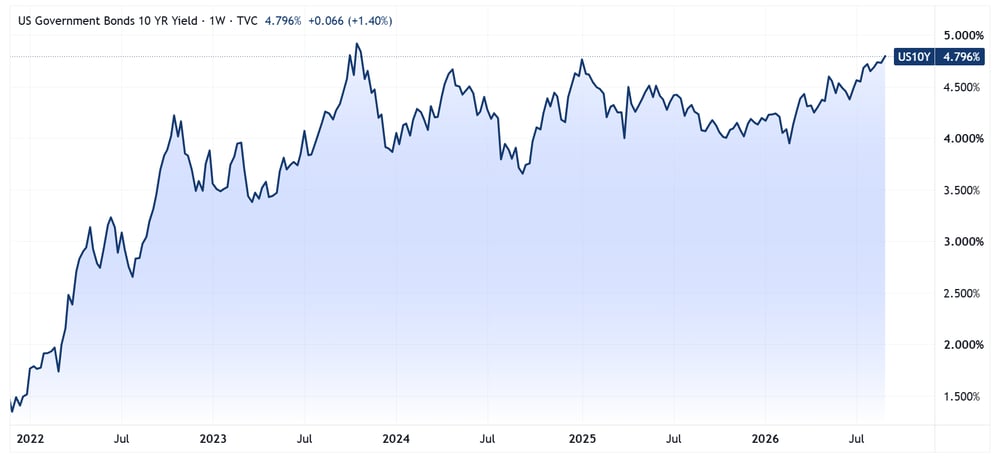
[9:01 am] The US 10-year yield rose 6 bps to 4.79%, trading fractionally above the January 2025 high, now at the highest since October 2023.
US 10-year yield (Source: TradingView)
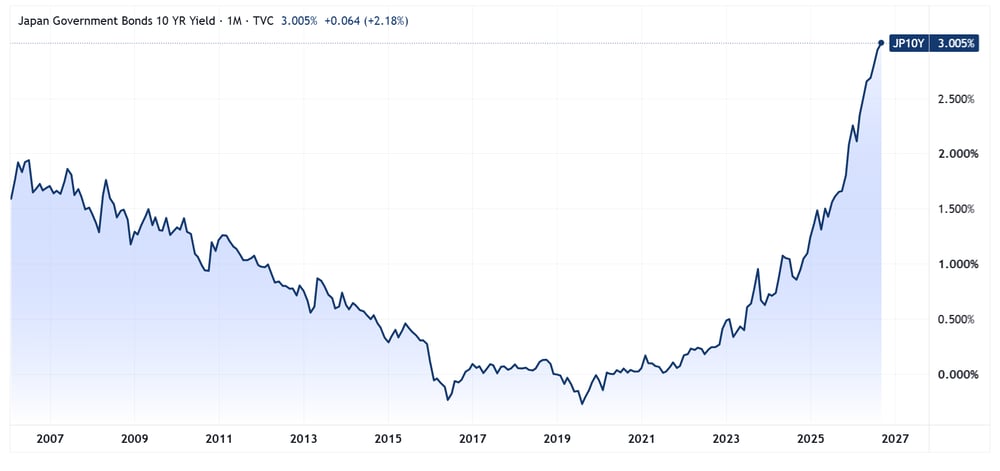
Japanese yields have been pretty much vertical in the past five years. Though the 10-year was trading at just 2.0% at the beginning of this year.
Japanese 10-year yield (Source: TradingView)
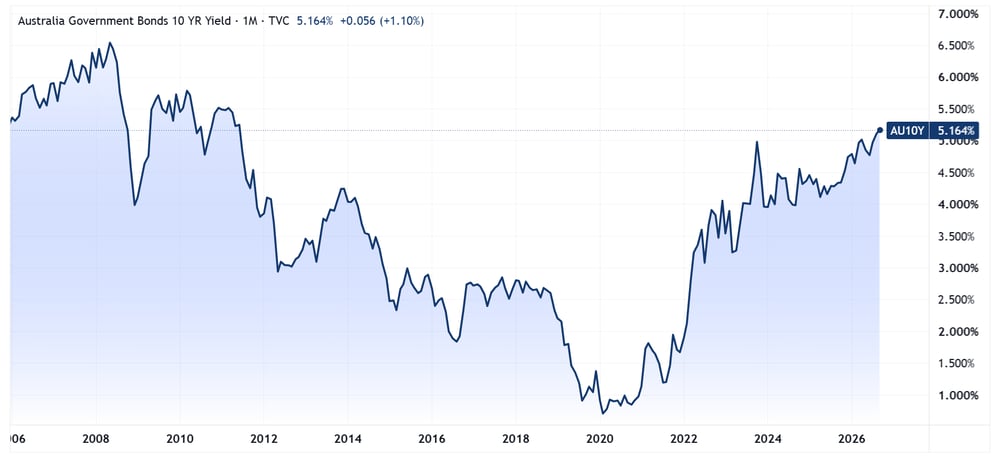
The Aussie 10-year continues its ascent, still climbing June 2011 levels.
Australian 10-year yield (Source: TradingView)
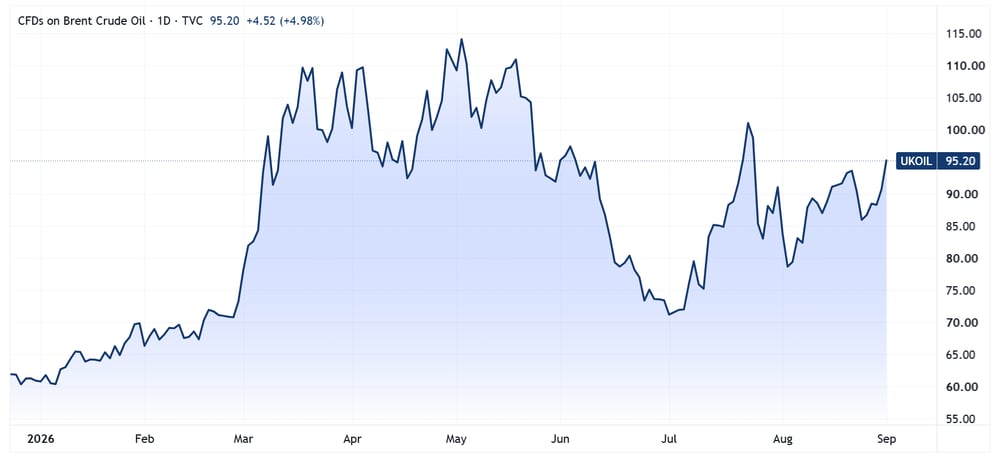
Brent is now up 35% since July but still ~15% below those May highs.
Brent crude (Source: TradingView)
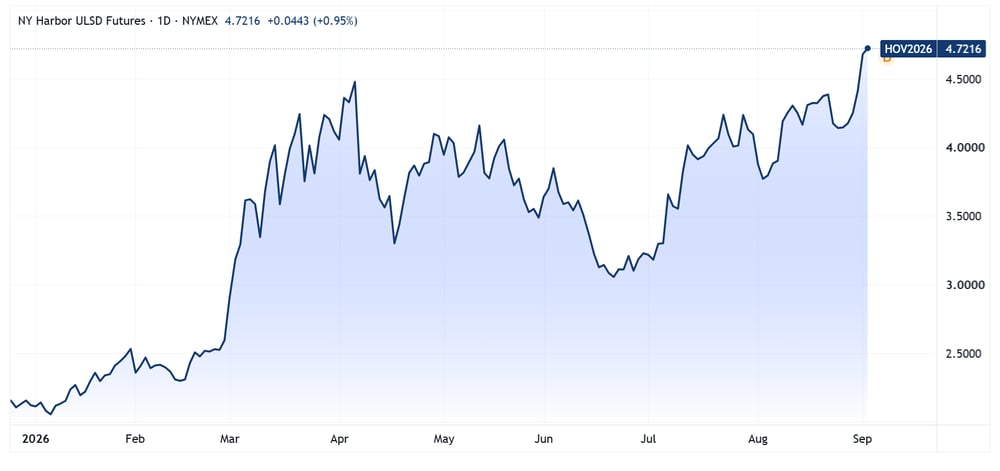
Despite oil trading ~15% below May highs, US diesel futures (NY Harbor ULSD futures) have surged to record highs.
NY Harbor ULSD futures (Source: TradingView)
Global data hardens the case for rate hikes
[8:50 am] August activity and inflation prints across the euro zone, the US and China all pointed the same way, with energy costs from the Iran war feeding into headline inflation just as central banks weigh further tightening
Euro zone headline inflation rose to 3.3% in August from 2.9% in July, the highest since September 2024, with energy inflation accelerating to 14.3% from 10.3% while core eased to 2.4% from 2.5%
ECB hike near fully priced, with markets putting a 98.9% probability on a 25bp increase to 2.5% at the 10 September meeting, following June's move to 2.25%
US ISM manufacturing fell to 54.6 from 55.6 in July against ests of 55.2, with new orders down to 53.7 from 56.7 and prices paid unchanged at an elevated 71.1
China's RatingDog manufacturing PMI rose to 51.5 from 50.9 against ests of 51, with the sharpest rise in new export business in six months, though 12-month confidence slipped to its softest since January and firms cut output prices for the first time this year
Japan's 10-year yield hits 3% for the first time since 1996
[8:45 am] The milestone caps a doubling in Japanese benchmark borrowing costs over the past year and comes as the yen sits above 160 per dollar, with a Bank of Japan hike now near fully priced
10-year JGB yield up 6 bps to 3%, the highest since 1996 and roughly double where it sat this time last year
Swaps imply about a 92% chance of a BOJ move by September, with an October increase more than fully priced and the benchmark rate currently at 1%, one strategist flagging the terminal rate repricing from 1.5% to 1.75% or higher
Tuesday's 10-year auction cleared with a bid-to-cover of 3.29 versus 2.56 last time and a 12-month average of 3.26, though a 30-year sale on Thursday looms as the harder test given fiscal concerns at the super-long end
Yen at 160.1 per dollar, a third straight session above the level traders watch for intervention, after Japan spent a record US$96.4bn over the past month supporting the currency
Bessent pressed Tokyo on rate hikes and fiscal sustainability in meetings with Finance Minister Katayama and BOJ Governor Ueda, saying he believes Japan will act in ways that lead to a stronger yen
Debt-servicing costs are set at a record ¥36.6trn (US$230bn) in the Finance Ministry's initial budget request for next year, with Takaichi yet to explain how a consumption tax cut on food will be funded
US strikes Iran again as Brent pushes above US$95
[8:41 am] The US and Iran traded a second round of attacks in as many days, sending oil to its highest since late July and putting the Strait of Hormuz back at the centre of the energy risk premium
CENTCOM struck IRGC targets in response to attempted attacks on commercial shipping in Hormuz and on US personnel, hitting Iran's southern coast including Bandar Abbas, Chabahar, Konarak and Qeshm Island
Iran fired 13 ballistic missiles at US bases in Jordan, with Jordan's military intercepting 10 and three falling in remote areas, and the IRGC vowing a response several times greater than the US attacks
Trump threatened escalation, saying Iran would be hit at a much harder level and that a bigger attack was still waiting in the wings, while claiming Iranian radar rebuilt around the strait had been destroyed
Hormuz traffic remains well below pre-war levels despite Trump saying the strait is clear of mines, with roughly a fifth of global oil supply moving through the waterway before the conflict
The war is in its seventh month, with Washington leaning on secondary sanctions on buyers of Iranian crude and Trump's approval at 33% ahead of November's midterms
Global bond yields back at 2008 highs as rate hike bets build
[8:40 am] A synchronised selloff has pushed sovereign yields to levels last seen before the financial crisis, driven by oil-fed inflation, wide fiscal deficits and record corporate issuance, and it is starting to weigh on the global equity rally
Global sovereign yields rose to 3.72%, the highest since mid-2008, with Japan's 10-year touching 3% for the first time since 1996 and UK 30-year yields at 1998 levels
US 10-year at 4.79% and the 30-year at 5.26%, back to where they sat before Bessent's 19 August move to at least double Treasury buybacks, which do not begin until 9 September
Australian 10-year yields notched their sharpest rise in five months to 2011 highs, with 30-year yields at a record in data going back to 2016, partly on fears of fewer Japanese buyers for Australian debt
Fed hike odds near 70% for the 15-16 September meeting, which would be the first increase since 2023, with an ECB rise fully priced for next week and a BoJ hike near certain this month
Investment-grade issuance has reached almost US$1.5trn this year, up 36%, with roughly US$200bn from the largest tech firms equal to about 25% of Treasury net issuance to private investors, five times the 2025 share
Good morning!
[8:26 am] ASX 200 futures are down 79 pts (-0.88%). Here's what happened overnight:
Stocks are set to fall on Wednesday after Wall Street finished broadly lower following US strikes on IRGC targets in Iran and bond yields continuing to hit fresh multi-year highs
S&P 500 (-0.71%), Nasdaq (-1.03%), Dow (-0.79%), Russell 2000 (-1.23%)
Brent rose ~5% overnight to US$95 a barrel, up ~35% since the 2-Jul low. What's worse is that a downstream barometer like US diesel futures (NY Harbor ULSD) surged 6.0% to all-time highs
The global bond rout deepened as Japan's 10-year yield hit 3% for the first time since 1996 and gilts led a worldwide selloff, with Fed hike odds for September now near 70%