Interest rate cuts are coming: Latest expert views on when and how much
Yesterday's employment report has turned the tide on interest rates say the experts – this is when the first rate cut is likely to occur.


Source: Market Index
KEY POINTS
- The RBA has hiked interest rates five times this year, taking the cash rate to 4.85% as it battles stubborn inflation, while household budgets have been squeezed and property prices have fallen sharply.
- October's jobs data showed 43,500 jobs lost and sending unemployment to 4.9% – marking the largest two-month decline in employment since 2000, excluding COVID.
- We bring you the latest reactions from three major investment banks, what the market says about the timing of the first rate cut, and where opportunities may exist for ASX investors.
It's been a brutal year for Australian borrowers. The Reserve Bank of Australia (RBA) has raised the cash rate five times in 2026, taking it to 4.85%, in a bid to bring inflation back under control. Mortgage holders are feeling the squeeze, and property prices have plunged.
Then came yesterday's October Labour Force report. Seasonally adjusted employment fell by 43,500, following September's 36,400 decline, and the unemployment rate jumped to 4.9% – the highest since October 2021.
The experts' views on the economy and the future path of the official cash rate that’s so important to its success or failure – have changed overnight. Below, I bring you the latest from three of the major investment banks and, most importantly, when the market believes the first round of interest rate relief will arrive.
Expert takes: Is the Australian economy stuffed?
UBS called the October jobs report another disappointment, noting the fall came in well below its own forecast of a 15,000 increase and the market's expectation of 20,000 jobs added. Annual employment growth slowed to just 0.6%, the weakest since 2021, and the three-month average fell to a loss of 17,000 jobs a month. UBS now expects unemployment to rise to 5.25% in coming quarters.
Macquarie notes the 80,000 jobs lost over the past two months is the largest two-month fall since 2000, excluding COVID, with 112,000 part-time roles lost against a 32,000 rise in full-time jobs. It points out that the rise in unemployment has been driven by workers aged 25 and over, a less volatile group than younger workers, suggesting labour demand is genuinely weakening. Macquarie also notes that some of the fall may reflect volatility in the survey sample.
Morgan Stanley described the result as 'material weakness', noting unemployment is already where the RBA expected it to be at the end of next year. The bank forecasts unemployment will climb to 5.4%, and says the data adds to the RBA Board's concerns about slowing activity, while stronger wages growth still points to persistent cost pressures.
Note none of the three banks is forecasting a recession yet – indeed UBS's strategists say explicitly they don't expect one. Let’s hope they’re right!
Interest rate relief is on the way
UBS has brought forward its forecast for the first rate cut to August 2027, from November 2027, and no longer expects any further hikes. It now sees a 75 basis point easing cycle (up from its previous forecast for 50 basis points), with cuts in November 2027 and February 2028, which would take the cash rate to 4.10%.
Morgan Stanley expects an extended hold from here, before cuts in August and November 2027 that would take the cash rate to 4.35% by the end of next year.
Macquarie says the data strengthens the view that the RBA's tightening cycle is finished, and that a continuation of the recent labour market weakness could see the RBA begin to reverse some of its rate as soon as mid-2027.
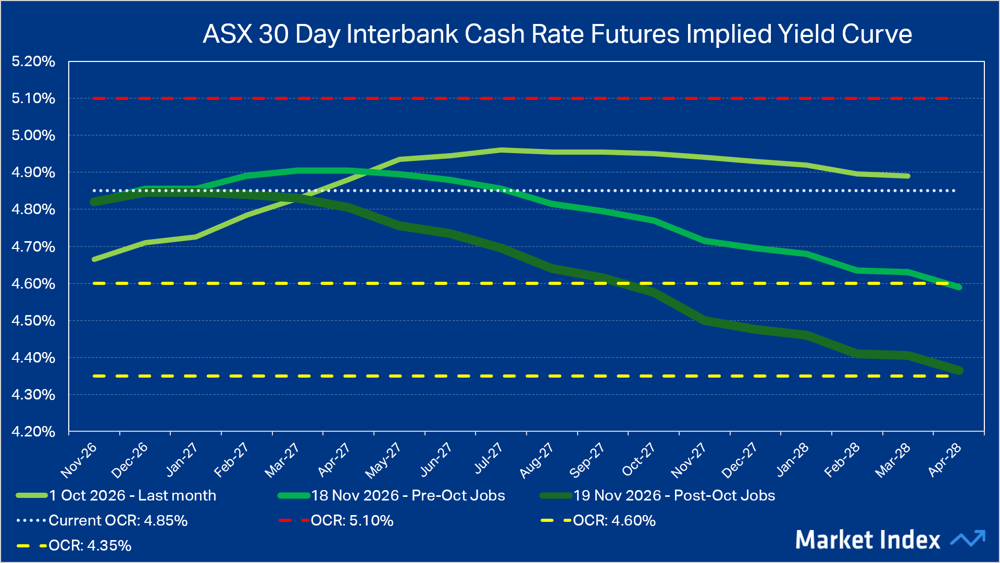
ASX 30 Day Interbank Cash Rate Futures implied yield curve
Takeaways from the Cash Rate Futures implied yield curve chart:
Six weeks ago the market expected rates to keep rising. On 1 October, with the cash rate at 4.60%, futures priced a peak of about 4.96% by mid-2027. That’s more than one further hike on top of the one the RBA delivered in November. The curve was still 4.89% by March 2028, so no cuts were priced at all.
By the eve of the jobs data the hike bets had mostly faded. On 18 November the curve peaked at just 4.905% in March–April 2027, only slightly above today’s 4.85% cash rate. A single cut was priced by April 2028, when the curve fell to 4.59%.
The October jobs report wiped out the last of the hike risk overnight. On 19 November the curve fell below the current cash rate from February 2027 onwards. Contracts from mid-2027 dropped 15–22 basis points in one session. A first cut is now fully priced by October 2027, with August 2027 at 4.64%, about an 85% chance. A second cut is almost fully priced by April 2028, at 4.365%.
Where should ASX investors be looking to buy the dip?
UBS's equity strategists believe peak rates are now behind us, making a 'rate pivot' trade into domestic consumer and housing cyclicals look tempting. But they caution it's still too early, with the risk of earnings downgrades building. Recent trading updates show sales growth running flat on the previous corresponding period, down from 1.1% in August and 3.4% in February – and with inflation running at around 4%, that means volumes are going backwards.
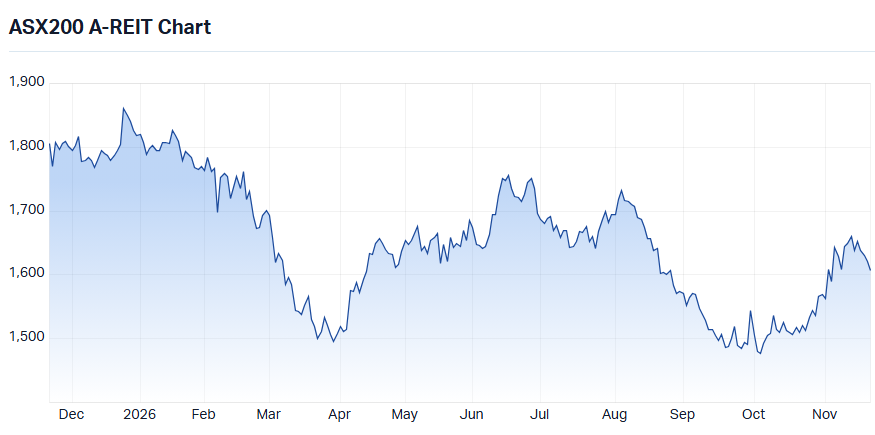
S&P-ASX 200 Real Estate Sector Index (XJR) intraday chart
UBS's preferred starting point is Real Estate, which it upgraded to neutral in early October. The sector has historically been first to move and has the highest sensitivity to a rate pivot, and UBS says it remains as cheap relative to the market as it has been outside the GFC. It prefers names without housing exposure.
Consumer Discretionary has historically had the second-highest sensitivity to a rate pivot, but UBS remains underweight, arguing valuations aren't yet cheap and earnings risks are building. It's also underweight the Banks, citing stretched valuations and growing tail risks to earnings as unemployment rises.
Is there really 'always' a silver lining?
The economy is bad, and that's typically not good for stocks. But the stock market looks forward, not backward, and investors will start trying to price the risk of the economy getting worse against the timing of it eventually getting better.
Next week's October CPI print on 25 November and the RBA's 8 December decision will shape that calculation, followed by November's jobs data on 17 December. As always, the trend is your friend, so watch closely the performance of the most interest rate sensitive sectors like real estate, consumer discretionary and the big banks.
References: This article draws on the ABS Labour Force, Australia, October 2026 release (19 November 2026); and broker research from UBS (Australian Economic Comment and Australian Equity Strategy, 19 November 2026), Macquarie (Australian Labour Market: Could we see a policy reversal?, 19 November 2026) and Morgan Stanley (Australia Macro+: October Labour Force – Material Weakness, 19 November 2026).